What Is Salah?
A simple, authentic introduction to the five daily prayers, written for young learners and families.
Listen: A gentle introduction to Salah
Two-minute audio: the Night Journey, five prayers, and Fard, Sunnah, and Nafl in simple language.
How the five prayers were given
Salah is one of the most important parts of Islam. It is how a Muslim stops during the day, remembers Allah, and speaks to Him.
During the Night Journey and Mi’raj, Allah gave the Prophet Muhammad ﷺ the gift of prayer. At first, fifty prayers were given. Then, through Allah’s mercy, they became five prayers each day and night, with the reward of fifty.
The Qur’an tells us that Allah took His servant by night from Masjid al-Haram in Makkah to Masjid al-Aqsa in Jerusalem. This journey is called Al-Isra. It was a special sign from Allah and showed the honour Allah gave to the Prophet Muhammad ﷺ.
For young learners, explain it simply: Allah took the Prophet ﷺ on a special night journey and showed him great signs.
Source: Qur’an 17:1
After the Night Journey, the Prophet ﷺ was taken up through the heavens. This is called Al-Mi’raj. In the authentic hadith, he met several prophets. One of them was Prophet Musa عليه السلام.
This part of the story helps learners understand that Salah was not simply invented later. It was given as a special command from Allah during this great journey.
Source: Sahih al-Bukhari 349
At first, fifty prayers were given for each day and night. When the Prophet ﷺ met Musa عليه السلام, Musa advised him to ask Allah to make it lighter for the people. The Prophet ﷺ returned and asked Allah. This happened until the prayers became five each day and night.
Allah, in His mercy, kept the reward very great: five prayers in action, but fifty in reward. This teaches children that Salah is both a duty and a mercy from Allah.
Source: Sahih al-Bukhari 349
The Prophet ﷺ did not choose the prayer times by himself. Jibril عليه السلام came and demonstrated the prayers. He prayed Fajr, Dhuhr, Asr, Maghrib, and Isha, and the Prophet ﷺ followed him.
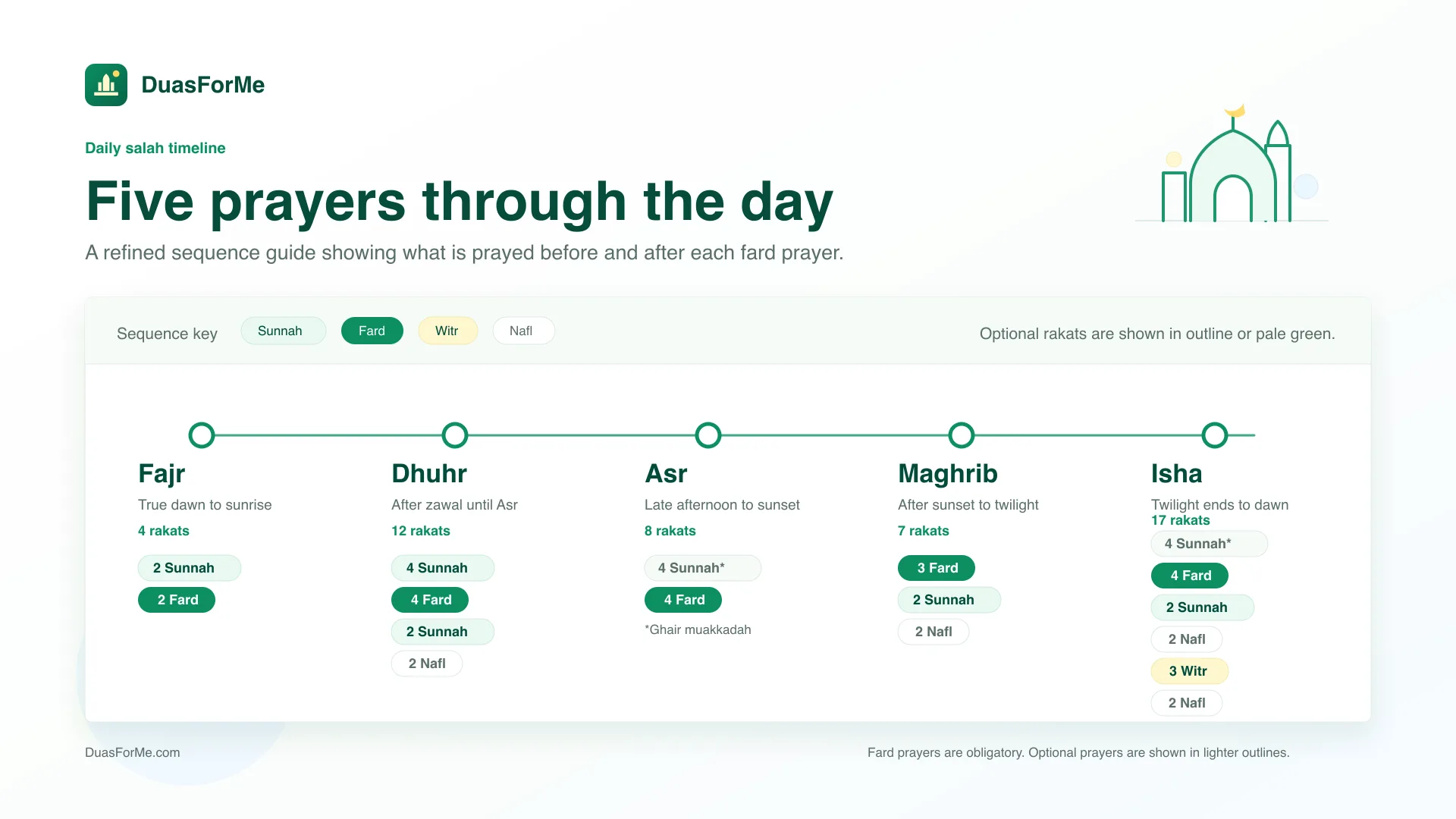
The Qur’an also teaches that prayer has appointed times. That means each prayer belongs to a part of the day: Fajr at dawn, Dhuhr after midday, Asr in the afternoon, Maghrib after sunset, and Isha at night.
Sources: Sahih al-Bukhari 521/522; Qur’an 4:103
Quick check
Allah took the Prophet ﷺ from Masjid al-Haram in Makkah to Masjid al-Aqsa in Jerusalem.
Muslims pray five daily Fard prayers: Fajr, Dhuhr, Asr, Maghrib, and Isha.
Fard means required. Fard Salah is the prayer Allah has commanded us to pray.
A rak’ah is one unit of Salah, including standing, reciting, bowing, and prostrating.
In the hadith of Mi’raj, the prayers were reduced to five, but Allah kept the reward like fifty.
- Qur’an 17:1: the Night Journey from Masjid al-Haram to Masjid al-Aqsa.
- Sahih al-Bukhari 349: fifty prayers reduced to five, with the reward of fifty.
- Sahih al-Bukhari 521/522: Jibril demonstrated the prayer times.
- Qur’an 4:103: prayer is prescribed at appointed times.
- Jami‘ at-Tirmidhi 414: regular Sunnah rak’ahs around the daily prayers.